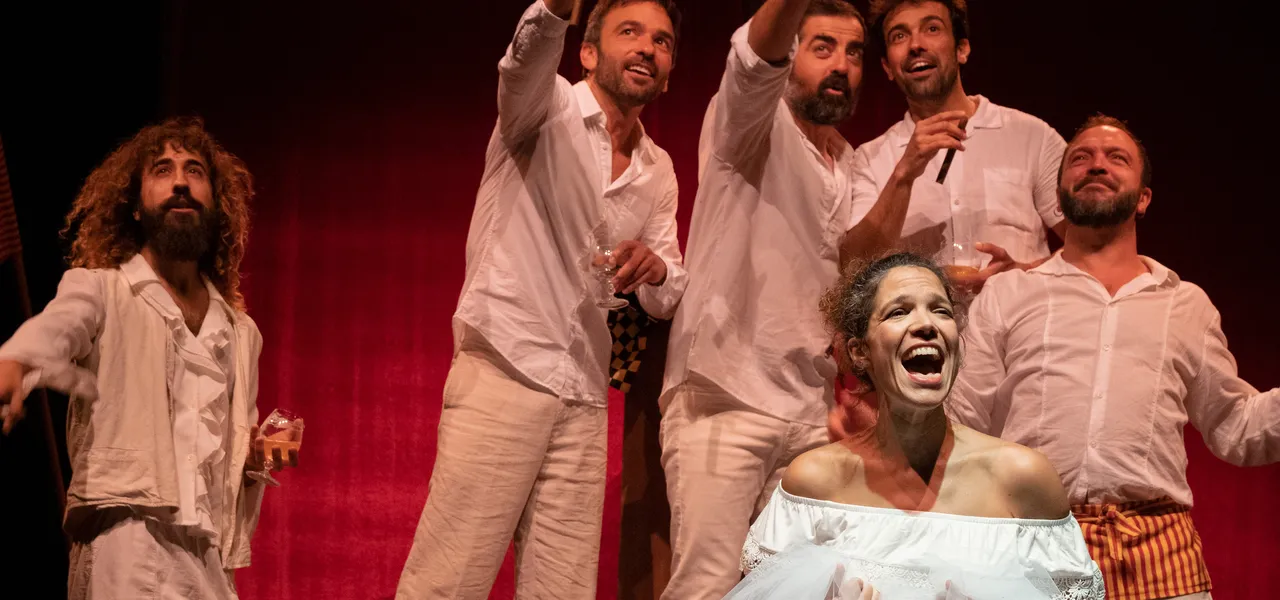
Arminda is a shepherdess who lives within the court of the Count of Barcelona. Don Ramon, the Count's nephew and heir, falls in love with her. Conflict arises between them because this love gets in the way of the political marriage arranged for Don Ramon. From then on, Arminda's life is decided by everyone without her opinion mattering at all. The conflict grows: Arminda goes to prison, Don Ramon leads a revolt, the Count condemns them to death... Finally, Arminda's father reveals a series of secrets that make the Count of Barcelona understand that she is really his daughter and that Arminda's marriage to Don Ramon is necessary.
La Trup wanted to intervene in this classic plot. Always fully aware of the historical context of the play (written in 1771 by Joan Ramis i Ramis), but applying a critical view of the patriarchal values it conveys, the ideas that have emerged from La Trup's creative laboratory range from the play to the monologue, without forgetting the original music, to provide, in short, a subjective and poetic view based on the actual present of the actors, the actress and the audience.
Director
Sergi Marí
Playwriting
Joan Ramis i Ramis, p, for the 1771 text; Montse González Parera, Agnès Romeu Aizpeitia, Sergi Marí
Cast
Queralt Albinyana, Rodo Gener, Eugeni Marí, Josep Mercadal, Xavier Núñez, Àlvar Triay
Stage design
Marga de la Llana
Lighting
Sergi Marí
Costumes
Marga de la Llana
Original music
Pere P. Ripoll
Musical director
Queralt Albinyana
Musical consultant
Pere Pelegrí
Jester consultant
Marc Fonts
Stage combat
Rodo Gener
#armindaunahistoriadhomes
 @latrupteatre @xavinunezactor @queraltalbinyana @alvartriaysales @josepmercadallopez @rodogener @mmalgenii @sergimarip @la_romeu @perepelegriripoll @montsegonzalezparera
#ElPrincipalPuntdeTrobada
@latrupteatre @xavinunezactor @queraltalbinyana @alvartriaysales @josepmercadallopez @rodogener @mmalgenii @sergimarip @la_romeu @perepelegriripoll @montsegonzalezparera
#ElPrincipalPuntdeTrobada
 Teatreprincipaldepalma
teatreprincipal
Teatreprincipaldepalma
teatreprincipal
 teatreprincipal